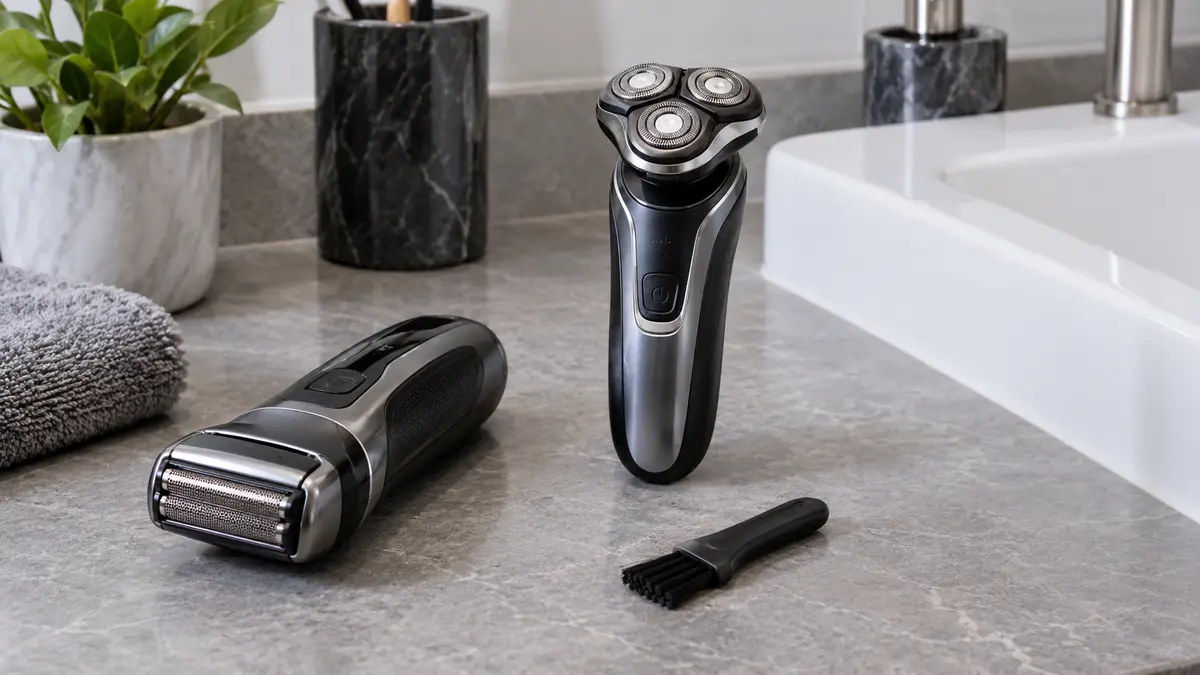
Foil versus rotary is the first useful decision when buying an electric shaver. Everything after that is about how the shaver handles your beard and skin.
A huge motor-speed number or an extra cutter does not matter much if you need fifteen irritated passes to catch the whiskers under your jaw.
Foil and rotary shavers to compare
Replacement-head cost matters over time. Check availability before choosing a model.
Foil shavers like straight passes
A foil shaver uses a thin perforated screen over rapidly moving cutters.
They tend to work well with shorter growth and people who shave in fairly straight, controlled strokes.
If your beard lies mostly in predictable directions, foil is a very sensible place to start.
Rotary shavers handle contours and mixed growth well
Rotary heads use circular cutters and flexing head assemblies.
They often do well around the chin, jaw and neck, especially when hair grows in several directions.
The technique is different. Small circular motions usually work better than long straight strokes.
Map your beard before blaming the hardware
Run your hand over your face in different directions after a day or two of growth.
Neck hair in particular can grow sideways, diagonally and occasionally as if it has declared independence.
Shave against or across the growth direction according to the device instructions and your skin tolerance. Changing angle can fix missed patches without buying another shaver.
Closeness and comfort trade places
Pushing harder rarely improves an electric shave.
It usually creates more irritation while the cutters do roughly the same job.
Use light pressure and let the shaver work. If you need many passes over the same area, technique, head wear or model fit may be the issue.
Wet/dry can mean several things
Some shavers are washable under the tap. Some can actually be used with shaving cream in the shower. Some are cordless-only around water.
Read the exact instructions. “Wet/dry” is not permission to use every shaver every possible way near a sink.
Replacement heads are part of the purchase price
Foils and cutters wear. Rotary heads wear.
Before buying, search for the exact replacement part and see what it costs.
A cheap shaver with a $55 replacement head that disappears from the market in two years is not necessarily cheap.
Cleaning stations are convenient, not free
Automatic cleaning docks can sanitize, lubricate and charge with very little effort.
They also take counter space and often require proprietary cleaning cartridges.
If you will happily rinse the shaver manually, you may not need the station.
Battery behavior matters after the honeymoon
Look at runtime, charging time and whether the shaver can operate while plugged in.
Some wet/dry models intentionally disable corded operation for safety. That is fine, but you want to know before the battery dies halfway through your face.
Travel lock and case are useful little details
A travel lock prevents the shaver from turning on in luggage.
A case should protect the foil or rotary heads without trapping moisture immediately after use.
Give your skin a fair trial
Technique changes can take a little time to get used to, but persistent pulling, cuts or rash are signs to reassess.
Clean the shaver, check the head condition, use lighter pressure and follow the manufacturer before deciding irritation is simply part of electric shaving.
The FDA maintains general consumer-product health information, although specific shaver use and maintenance comes from the device manufacturer. FDA consumer updates are here.
My quick choice
Foil: start here for short growth, straight passes and a close, controlled shave.
Rotary: start here for curved areas and beard growth that runs in several directions.
Then buy the model whose head fits your face, whose replacement parts exist and whose cleaning routine you will actually keep up with.
Shop by the criteria that matter
Amazon results change. Check each listing against the criteria in this guide.