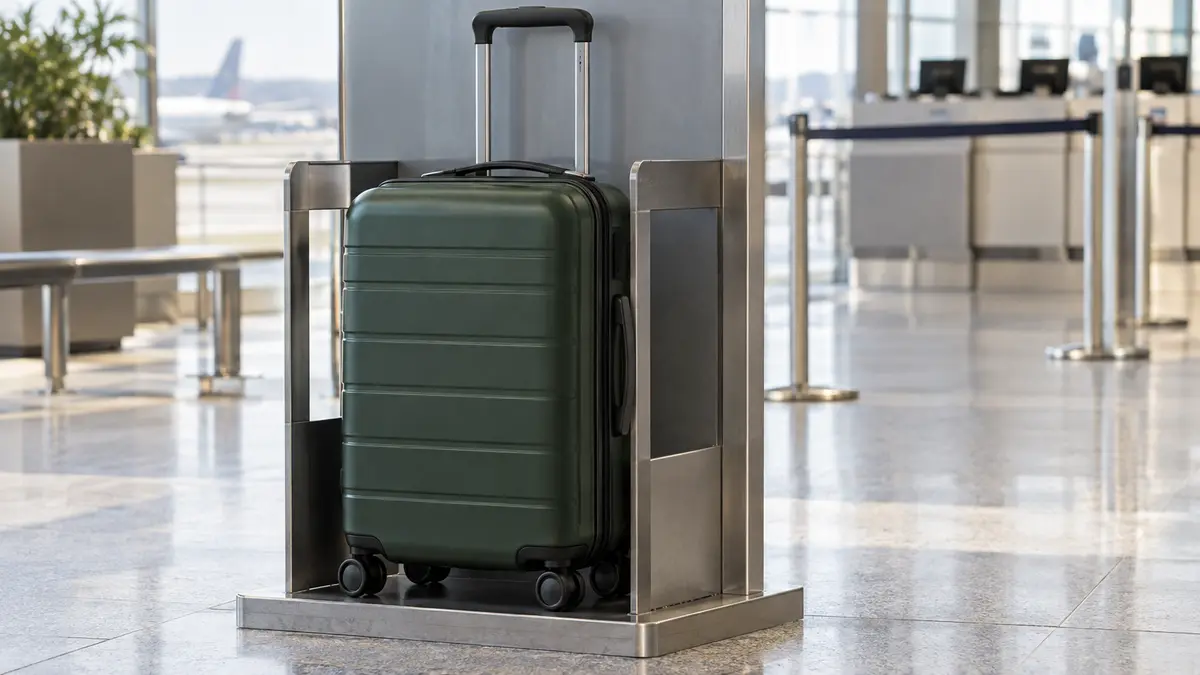
A carry-on should be one of the easier things to buy. Somehow it is not. A bag can have “22-inch carry-on” in the product name and still be too big once the wheels, handles and expansion zipper are included.
The safest rule is simple: ignore the size name and look for the full outside dimensions of the bag as it will actually go into the airline sizer.
For many large U.S. airlines, 22 × 14 × 9 inches is a familiar limit, but it is not universal. Airlines, fare types and partner flights can have different rules. Check the airline you are actually flying before you buy. The FAA also points travelers back to the individual airline for carry-on limits. FAA baggage guidance is here.
Start with bags that fit common carry-on dimensions
Amazon results change. Check the listed outside dimensions, including wheels and handles, against your airline before buying.
Measure the whole suitcase, not the boxy part
The airline does not care how the manufacturer decided to describe the bag. Wheels count. Handles count. Plastic feet count. If the front pocket is stuffed until it bulges, that counts too.
This is where a lot of “but it said carry-on” complaints come from. The listing may show a case height that excludes the wheels, or it may use a rounded size class like 20-inch or 22-inch instead of the complete dimensions.
When the product page is vague, I would rather skip the bag than spend the morning of a flight trying to persuade an airline employee that the marketing department meant well.
Expansion zippers can turn a legal bag into a checked bag
Expandable luggage is useful. It is also easy to forget that the extra couple of inches count.
If a bag is already right at the airline’s depth limit when closed, expanding it may make it too large for the overhead bin rules. That does not make expansion useless. It can be handy on the trip home if you are willing to check the bag. Just do not assume “carry-on” still applies after you unzip the extra gusset.
External size and usable space are not the same thing
Two bags with the same outside measurements can feel very different inside. Thick wheel housings, curved shells, giant telescoping-handle channels and bulky interior dividers all consume room.
Soft-sided bags can sometimes use awkward spaces a little better. Hard shells are usually more structured and easier to wipe clean. Neither automatically holds more. If capacity matters, look at the interior photos and the actual layout, not just a liters number that may have been calculated generously.
If you travel often enough that construction matters as much as size, our durable luggage guide digs into wheels, zippers, shells and handles.
Empty weight matters more than people think
A heavy bag starts spending your weight allowance before you pack the first shirt. That is especially annoying on airlines with stricter cabin-bag weight limits.
There is a tradeoff here. Very light luggage can give up structure or hardware. Very heavy luggage can feel reassuring in the store and miserable on stairs. I would compare empty weight after I have eliminated bags that do not fit the size rules.
Spinner wheels versus two wheels
Four-wheel spinners are wonderfully easy on smooth airport floors. You can roll them beside you instead of dragging them behind you. The downside is that the wheels stick out and take abuse.
Two-wheel bags usually have larger, more protected wheels. They can be nicer on rough sidewalks, brick streets and curbs, but they take more effort in a crowded terminal.
There is no universal winner. Think about where the suitcase spends its life after it leaves the airport.
A legal carry-on can still get gate-checked
This catches people by surprise. A bag can meet the published size limit and still end up in the cargo hold because the overhead bins are full or because the aircraft is small.
Keep medications, identification, keys, electronics and anything you absolutely cannot lose in a smaller personal item when possible. The FAA also has specific rules for spare lithium batteries and battery-powered luggage, so check those before flying. FAA PackSafe guidance is here.
What I would check before ordering
- The airline’s current height, width, depth and weight limits.
- Whether the luggage dimensions include wheels and handles.
- The depth with the expansion zipper closed.
- Empty weight.
- How much of the inside is lost to wheel wells and handle tubes.
- Whether the warranty actually covers wheels, handles and zippers.
- Owner photos showing the bag packed, not just studio photos of it empty.
Then measure the bag when it arrives while you can still return it. It takes about a minute and removes a lot of uncertainty.
A good carry-on is not the one that promises the most space. It is the one that fits the airline rules you actually use, holds enough for your trip and does not make you nervous every time you walk toward the gate.
Shop by the criteria that matter
Amazon results change. Check each listing against the criteria in this guide.