If a telescope box is screaming “675x magnification,” that is usually a good reason to stop listening to the box.
A telescope’s first job is to gather light and form a good image. Magnification comes after that. A steady, sharp 80x view of Saturn is much more useful than a dim blob wobbling around at a theoretical 675x.
Beginner telescope types to compare
Aperture and mount stability matter more than advertised maximum magnification.
Refractors use a lens at the front
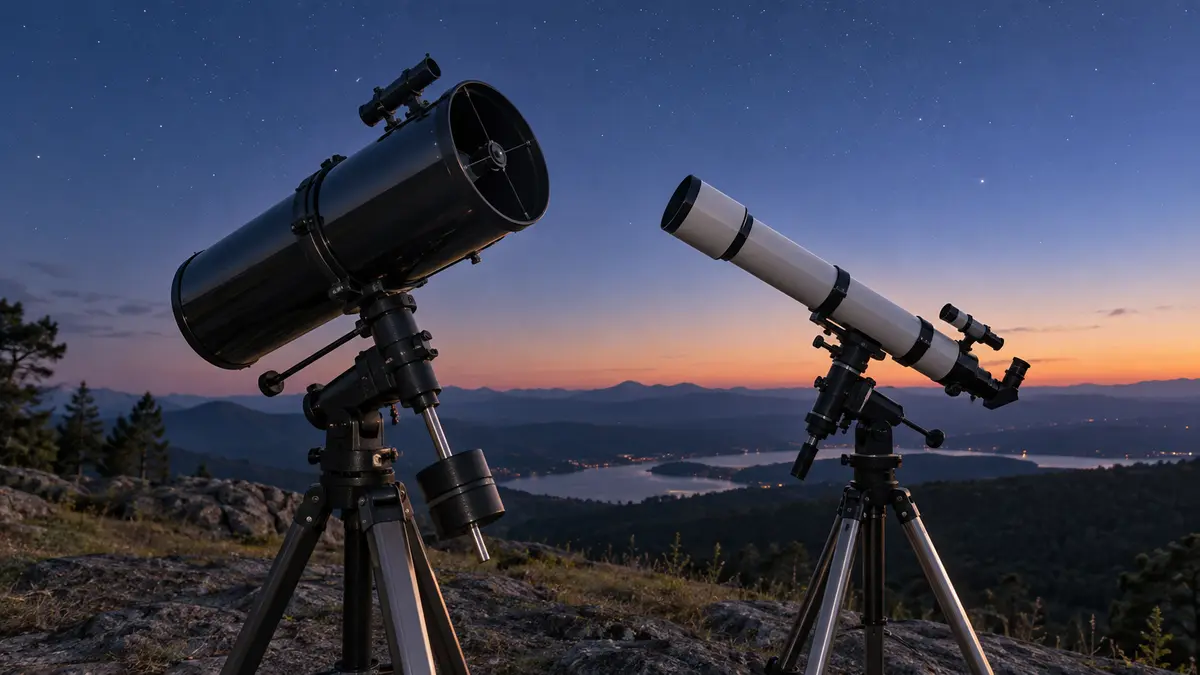
A refractor is the classic telescope shape most people picture. Light passes through the front objective lens and comes to focus at the back.
They need little routine alignment, are easy to grab and use, and work very well on the Moon, planets and bright objects.
The downside is that large high-quality lenses become expensive quickly.
Reflectors use a mirror
A reflector uses a curved primary mirror to gather light. That lets you get more aperture for the money, which is one reason Dobsonian reflectors are popular first serious telescopes.
They do need occasional collimation, which means aligning the mirrors. That sounds frightening until you learn it, then it becomes basic maintenance.
Aperture is the number I care about first
Aperture is the diameter of the main lens or mirror. More aperture gathers more light and can reveal fainter objects and finer detail when the atmosphere cooperates.
But a giant telescope you hate carrying outside may show less in practice than a smaller telescope you use constantly.
The mount is half the telescope
Bad mounts ruin good optics.
At high magnification, tiny vibrations become giant image movement. Tap the focuser and see how long the view takes to settle.
A simple, sturdy Dobsonian mount often beats a complicated lightweight tripod that looks more “advanced” but wobbles in a breeze.
Useful magnification changes with the night
Atmospheric turbulence, object brightness, aperture and optical quality all limit how much magnification is useful.
Start low. Find the object. Center it. Then increase magnification until the image stops improving.
Eyepieces matter, but you do not need twenty
A low-power eyepiece gives a wide field for finding objects. A medium-power eyepiece covers a lot of Moon and planet viewing.
Add more only when you know what gap you are trying to fill.
Finders make the telescope usable
A red-dot finder or optical finder helps you aim.
Align it during the day on a distant terrestrial object, never the Sun, so that when darkness comes the finder and main telescope point at the same place.
Solar viewing has one absolute rule
Never look at the Sun through a telescope without a properly designed solar filter placed over the front aperture.
Eyepiece solar filters and improvised materials are dangerous.
NASA and Night Sky Network resources provide observing guidance and astronomy education. A Night Sky Network telescope resource is here.
Which would I choose?
Small refractor: easy setup, low maintenance, good for Moon and planets, useful when portability matters.
Dobsonian reflector: more aperture per dollar, excellent for a broad range of objects, simple sturdy mount, occasional collimation.
If I wanted one first telescope for backyard visual astronomy and could store and carry it, I would look very hard at a 5- or 6-inch Dobsonian before buying anything with a huge magnification number on the box.
Shop by the criteria that matter
Amazon results change. Check each listing against the criteria in this guide.