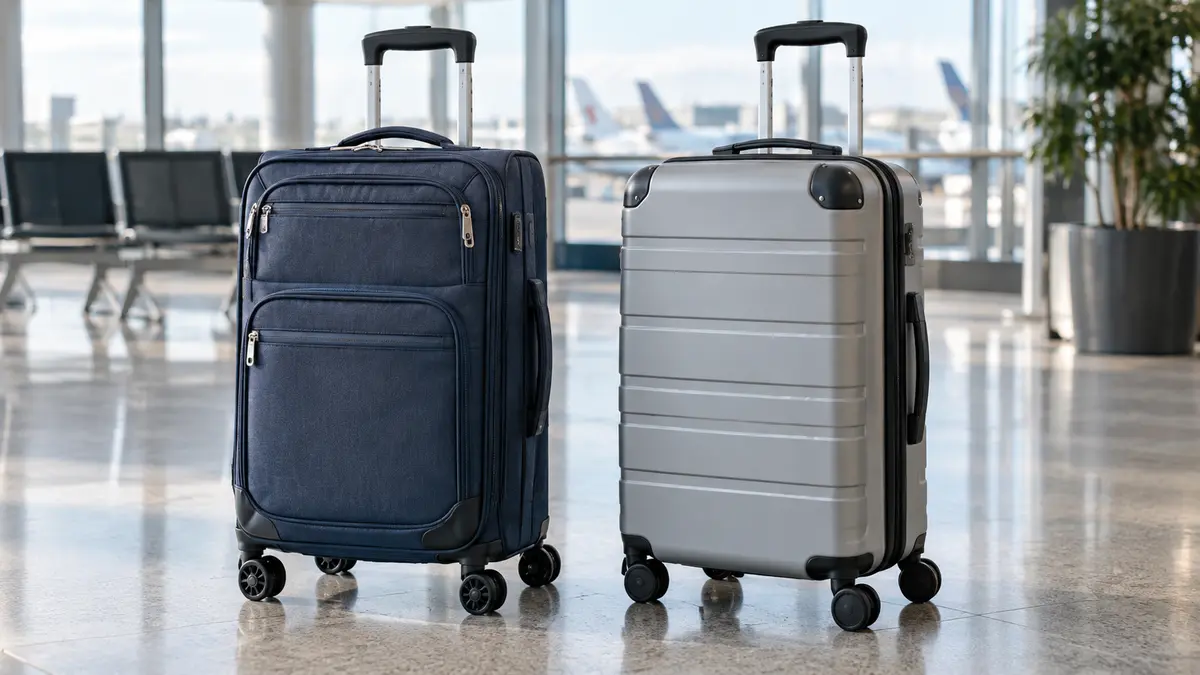
If you want luggage that lasts, start by looking at the parts that move. The shell gets all the marketing attention, but wheels, handles, zipper corners and attachment points are where suitcases usually start giving you trouble.
A mediocre suitcase made from a fashionable material is still mediocre. A simpler bag with protected wheels, solid handle mounts and repairable hardware can be a much better buy.
A few useful places to start
These are broad searches, not endorsements of every result. Look closely at wheel mounts, handle construction and repairability.
Hard shell or soft shell?
Neither one wins automatically.
Hard-sided luggage is easy to wipe down, resists casual crushing and does not have fabric that can snag. Soft-sided luggage usually gives you exterior pockets, a little more give when packing and fewer worries about a shell cracking.
If you fly a lot, I would care more about how the corners, wheels and handles are attached than whether the side panel is fabric or plastic.
Polycarbonate, polypropylene and ABS
These names show up constantly in hard-sided luggage listings, and they are often presented as if one word settles the durability question.
It does not.
Polycarbonate is commonly used because it can flex rather than simply crack under impact. Polypropylene can also be tough and relatively light. ABS is inexpensive and can be perfectly adequate, but thin ABS shells tend to be less forgiving of rough treatment.
Thickness, ribbing, corner design and how the hardware is mounted matter right along with the material itself.
Look at the wheels before you fall in love with the shell
Spinner wheels make airport floors easy. They are also sitting out at the corners waiting to be smacked into curbs, conveyor edges and baggage equipment.
Look for wheels that are partially protected by the case and mounted into a substantial housing. Owner photos are useful because they show whether a wheel is attached to a sturdy molded section or what looks like a small plastic tab.
If your travel includes rough sidewalks, cobblestones or a lot of walking outside the terminal, bigger two-wheel designs can be more durable and easier to drag over bad surfaces.
The telescoping handle should not feel like a radio antenna
A little play in a telescoping handle is normal. A lot of wobble when the bag is empty does not inspire confidence.
Extend it fully. Pull the suitcase around. Twist gently. Make sure both rails lock at the same height and that the release button does not stick.
Then check the grab handles. They take the full weight of the packed suitcase when you lift it into a trunk or onto a scale. I like handles that are visibly anchored into the case rather than disappearing into a thin trim panel.
Zippers deserve more attention than they get
A zipper usually fails at a corner or where the bag is overstuffed and the two sides are pulling away from each other.
Run the zipper around the empty bag and again after packing it. It should move without needing two hands and a negotiation.
On hard cases with latches instead of zippers, check the hinge and latch alignment. A latch system can be sturdy, but a bent frame or misaligned closure can make the whole case difficult to use.
Do not mistake stiffness for strength
A rigid suitcase feels substantial in a store. That does not necessarily mean it will survive better.
Some shells are designed to flex and spring back. Some soft-sided bags use reinforcement where the stress actually occurs. The useful question is not “Which one feels hardest?” It is “What happens when the bag is dropped, twisted, rolled and lifted while full?”
Warranty and replacement parts are part of durability
A ten-year warranty headline is not very useful if wheels and handles are excluded or if getting a replacement part requires shipping the whole suitcase across the country.
Look for clear warranty terms and evidence that common wear parts can be replaced. A $15 wheel can keep a good suitcase alive. A proprietary wheel that does not exist anymore can turn a small failure into a new-luggage purchase.
Use the return period like a test drive
Pack the bag with a realistic load. Roll it across carpet and a sidewalk. Lift it by every handle. Extend and collapse the telescoping handle several times. Zip it around full corners.
You are not trying to abuse it. You are trying to find the annoying thing you would otherwise discover three terminals away from home.
If you are buying a carry-on specifically, check our carry-on sizing guide too. A beautifully built suitcase that misses your airline’s size limit is still the wrong suitcase.
The durable choice is usually not mysterious. It has sensible hardware, protected stress points, parts that can be repaired and a design that still feels solid when the bag is actually loaded.
Shop by the criteria that matter
Amazon results change. Check each listing against the criteria in this guide.