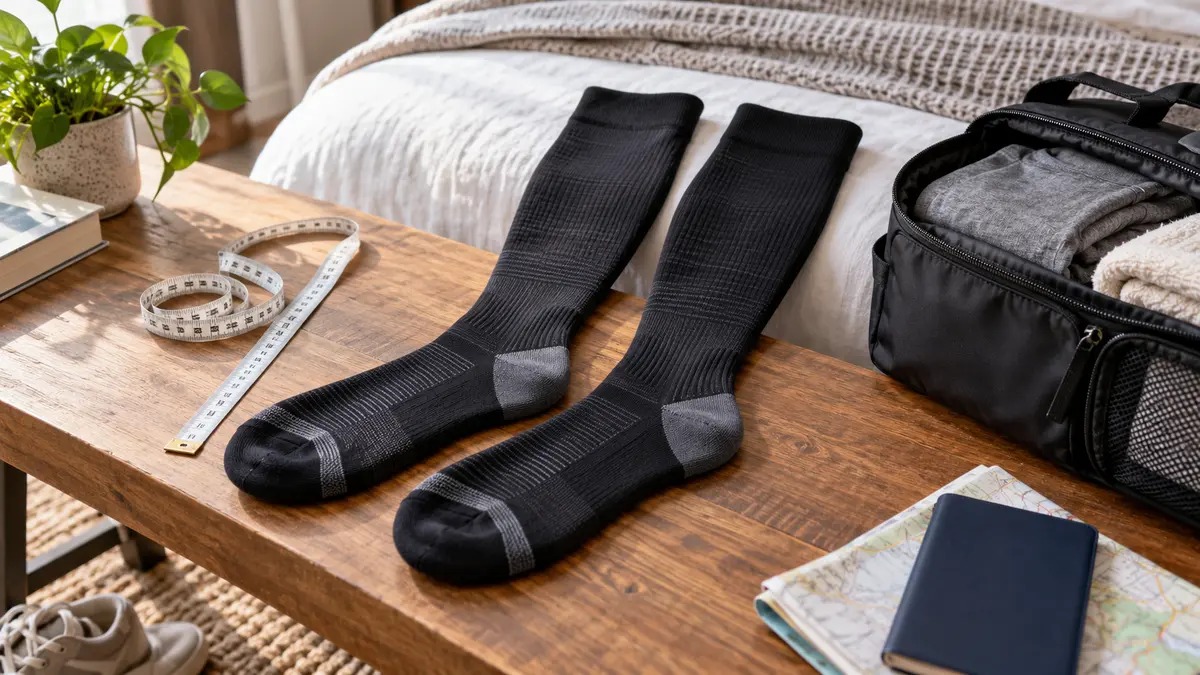
Most people shopping for travel compression socks do not need a lecture on hosiery. They need to know three things: what pressure range makes sense for them, what size actually fits, and whether they can stand wearing the things for six or eight hours.
For an otherwise healthy traveler who simply wants a little help with the heavy, puffy-leg feeling that can come with a long flight, the shopping side is fairly straightforward. Look for graduated compression, use the manufacturer’s ankle and calf measurements, and do not buy a stronger pair just because the number sounds more serious.
If you have had a blood clot, have significant circulation problems, are pregnant, recently had surgery, have active cancer, or have another reason to think your clot risk is higher than average, this stops being an ordinary sock-shopping decision. The CDC recommends talking with a doctor about prevention for higher-risk travel. Here is the CDC’s travel guidance.
If you already know what you need
These are broad Amazon searches, not endorsements of every sock in the results. Check the pressure range and the brand’s sizing chart before buying.
Do not buy them by shoe size alone
This is probably the easiest mistake to make. Compression socks are not ordinary socks that happen to be tight. The whole point is controlled pressure, usually strongest near the ankle and gradually lighter farther up the leg.
That means your ankle and calf matter more than whether you normally buy a men’s 10 or a women’s 8.
Use the sizing chart for the exact pair you are considering. Most knee-high charts ask for ankle circumference and calf circumference. Some also want calf length or shoe size. Measure both legs rather than assuming they are identical.
If one measurement says medium and another says large, I would not play “close enough” with it. Check the manufacturer’s instructions or look for a brand with a size chart that actually fits your measurements.
What does 15–20 mmHg mean?
The pressure number on compression socks is listed in millimeters of mercury, or mmHg. You will see ranges such as 15–20, 20–30, and higher.
For shopping purposes, 15–20 mmHg is a common mild-to-moderate retail range you will see on travel socks. That does not mean everybody getting on an airplane should automatically wear it, and it definitely does not mean that somebody with a medical reason for compression should pick a number from an Amazon listing.
The CDC’s 2026 Yellow Book notes that some higher-risk long-distance travelers may benefit from properly fitted below-the-knee graduated compression stockings, and it discusses 15–30 mmHg in that specific higher-risk context. That is medical guidance for risk management, not a reason to buy the strongest pair you can find. You can read the CDC Yellow Book discussion here.
Knee-high is the simple place to start
For ordinary travel shopping, knee-high compression socks are the easiest style to understand and live with. They fit under pants, work with most shoes, and do not create the extra sizing problems of thigh-high garments.
The top should finish below the knee crease. If the sock is so long that it bunches behind your knee, or so tight at the top that you immediately want to fold the cuff over, the fit is wrong. Folding the top down is not a clever fix. It creates a tighter band right where you do not want one.
Open toe or closed toe?
This is mostly a comfort and fit decision.
Closed toe feels more like a normal sock and is the obvious choice for most people. Just make sure the foot portion is long enough. A compression sock that is constantly pulling your toes backward will make a long flight feel even longer.
Open toe can be useful if you hate pressure around your toes, have a foot shape that makes closed-toe compression uncomfortable, or simply prefer your toes free. The opening still needs to sit smoothly. If it rolls into a little tourniquet under the ball of your foot, that is not an improvement.
The sock has to work with your travel shoes
This sounds obvious until you put a thicker compression sock inside a shoe that was already snug.
Try the socks with the exact shoes you plan to wear. Walk around the house. Sit for a while. Make sure your toes still have room and that the heel of the sock stays where the heel is supposed to be.
I would much rather discover an annoying toe seam in the living room than somewhere over Nebraska with five hours left in the flight.
Put them on before you are already swollen
Compression socks are easier to put on before your legs have spent hours hanging down. Many people find morning easiest.
Do not grab the top and yank. Turn the sock partly inside out to the heel, get your foot and heel seated correctly, then work the fabric up gradually. Smooth wrinkles as you go.
If putting them on feels like a wrestling match every single time, that matters. A theoretically perfect sock that stays in the suitcase is not very useful.
Compression socks are not the whole travel plan
Sitting still for a long time is part of the problem during long-distance travel. The CDC recommends moving your legs frequently and getting up to walk periodically when you can. For trips longer than four hours, it also recommends knowing the signs of a blood clot and talking with your doctor if you have additional risk factors.
So, yes, the socks may be part of the plan. They are not a force field.
When I would stop shopping and ask a doctor
I would not treat compression level as a do-it-yourself decision if you have a previous blood clot, significant circulation disease, recent surgery or injury, active cancer, pregnancy or postpartum risk, a clotting disorder, or unexplained leg swelling.
And if you develop new one-sided swelling, unexplained leg pain or tenderness, warmth or discoloration, that deserves medical attention. Trouble breathing, chest pain, coughing up blood, lightheadedness or fainting can be signs of a pulmonary embolism and need urgent medical care. Those warning signs come directly from the CDC’s travel guidance.
My travel-shopping checklist
- Look for graduated compression with a clearly stated mmHg range.
- Use ankle and calf measurements, not just shoe size.
- Make sure the sock ends below the knee without bunching or rolling.
- Choose open toe or closed toe based on actual comfort, not marketing.
- Try the socks with your travel shoes before the trip.
- Make sure you can put them on without turning the process into a daily grudge match.
- If your reason for wearing compression is medical rather than ordinary travel comfort, get the pressure recommendation from a clinician.
That is really the buying decision. You do not need the fanciest fabric story or the most heroic pressure number on the box. You need a properly sized pair, a pressure level that makes sense for why you are wearing them, and a sock comfortable enough that you will actually leave it on.
Shop by the criteria that matter
Amazon results change. Check each listing against the criteria in this guide.