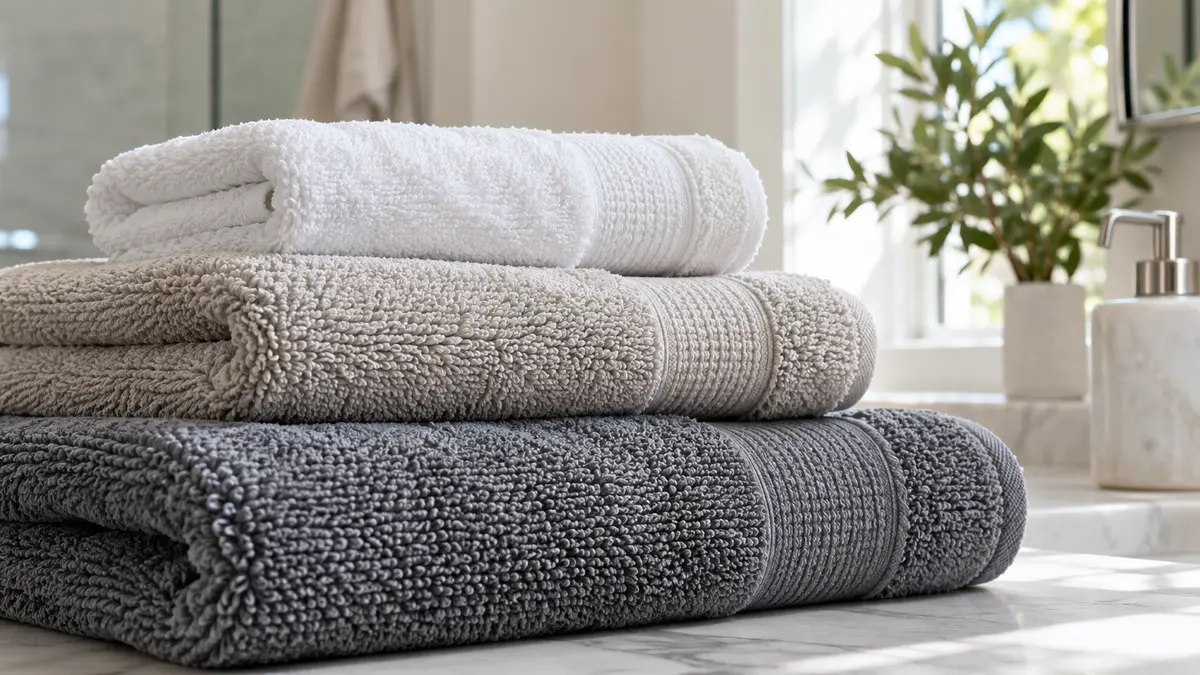
The softest towel in the store is not automatically the towel you will like living with.
Very thick towels feel luxurious when they are dry and freshly stacked. They also hold more water and can take forever to dry in a humid bathroom. If you have a family taking showers one after another, that matters.
Bath-towel styles to compare
GSM is a weight measurement, not a quality grade. Check size, loops, hems and how quickly the towel is likely to dry in your bathroom.
What makes a towel absorbent?
Most bath towels use terry construction, with loops of yarn standing up from the base fabric. Those loops create lots of surface area to pick up water.
Dense, even loops usually feel plush and absorb well. But more yarn also means more water to dry afterward.
GSM is useful when you know what it means
GSM means grams per square meter. It tells you how heavy the fabric is for its area.
A lower-GSM towel is usually lighter and faster to dry. A higher-GSM towel is generally thicker and plusher.
For an everyday bathroom, something in the middle is often the sweet spot. You get enough towel to feel substantial without hanging a wet bath rug on the rack every morning.
Cotton labels do not tell you everything
Terms like Egyptian cotton, Turkish cotton and long-staple cotton can be useful when they are accurate, but the final towel also depends on yarn quality, weave, finishing and construction.
The FTC has rules about textile fiber labeling, which is why the actual fiber-content label is more useful than a giant geographic adjective on the front. FTC textile-labeling guidance is here.
Size can become annoying
A huge bath sheet feels luxurious until it takes up the entire towel bar, fills half the washing machine and drags on the bathroom floor.
Measure the towel you already like. That gives you a much better reference than “oversized” in a product title.
Look at the hems
Towels often fail at the edges before the middle fabric is worn out.
Check for straight stitching, secure corners and decorative bands that do not feel noticeably tighter than the terry fabric.
Owner photos after washing are useful here. A towel with beautifully photographed loops and a hem curling like a potato chip is telling you something.
New-towel softness can be misleading
Finishing treatments can make a towel feel unusually silky in the package. That feel may change after the first few washes.
I care more about how a towel feels and absorbs after laundry day than how it performs under store lighting.
Skip the fabric softener if absorbency starts dropping
Fabric softener can leave a coating on fibers and reduce absorbency over time.
Wash according to the towel’s care instructions and use a sensible amount of detergent. If you want more detail on detergent dosing, see our laundry-detergent guide.
The bathroom decides how heavy you can go
If you have strong ventilation and towels have all day to dry, thick towels may work beautifully.
If the bathroom stays humid and four people shower before 8 a.m., faster-drying towels are likely to be less annoying and less musty.
My practical towel test
- Pick a size that fits the person and the towel bar.
- Choose a weight your bathroom can dry.
- Check that the loops look even and dense.
- Inspect hems and corners.
- Wash before judging the final softness.
- Buy enough towels to rotate without creating a linen-closet avalanche.
A good bath towel should get you dry and then get itself dry. That is the whole relationship.
Shop by the criteria that matter
Amazon results change. Check each listing against the criteria in this guide.