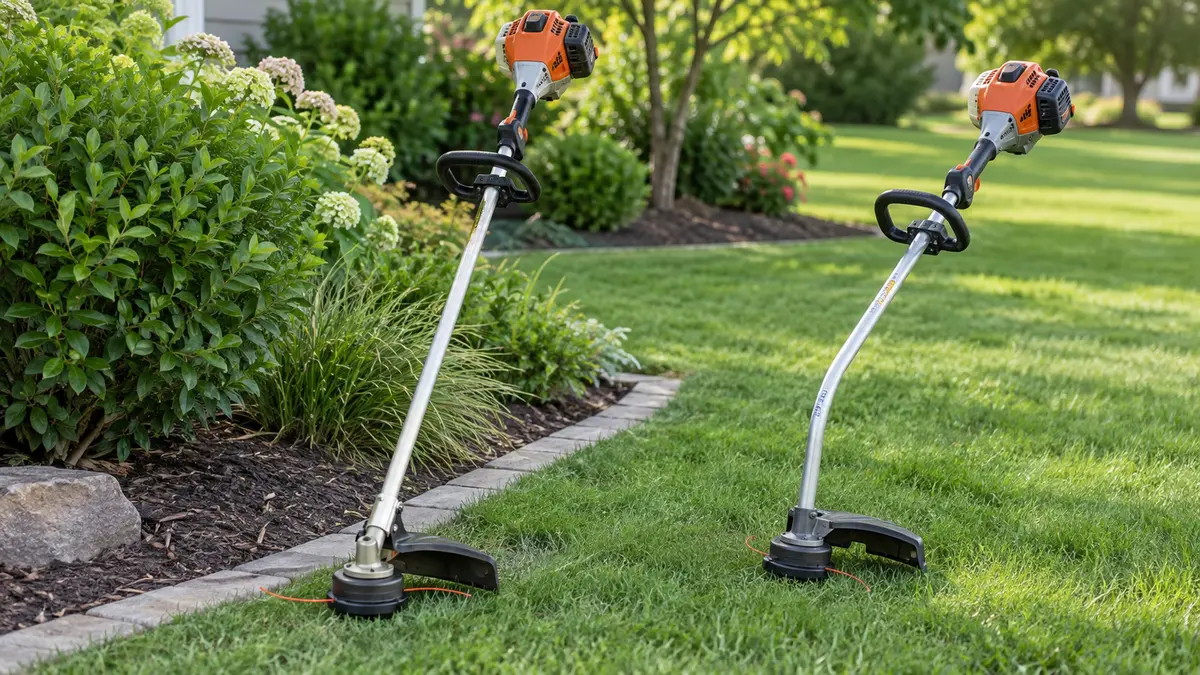
A string trimmer is basically a spinning head on the end of a lever, which means balance matters a lot more than the voltage number on the box.
A powerful trimmer that makes your wrists fight the tool for forty minutes is not a good trimmer for you.
String-trimmer types to compare
Hold the complete tool with battery or fuel weight if possible. Balance and line-feed design matter every minute you use it.
Straight versus curved shaft
A straight shaft gives you more reach under fences, shrubs and low obstacles. Taller users often prefer it too.
A curved shaft can feel lighter and more natural for smaller yards and shorter users.
Neither shape is automatically better. Hold both in working position and see where the cutting head lands without bending your back.
Battery trimmers are the easy default for many yards
They start instantly, need very little routine maintenance and are much quieter than gas.
Runtime depends on battery size, line diameter, vegetation and how hard you push the tool.
If you already own a mower, blower or saw on the same battery platform, that can be a strong reason to stay in the ecosystem.
Gas still makes sense for long or heavy work
For large properties, thick weeds and long sessions, gas gives you quick refueling and plenty of power.
You also get fuel storage, engine maintenance, noise and exhaust.
Corded electric is cheap and light if the yard allows it
A corded trimmer can be terrific in a small yard where an extension cord reaches everything safely.
If you spend the entire job untangling the cord from shrubs, it stops being a bargain.
Line-feed design can make or break the experience
Bump-feed heads release line when you tap the head. Automatic feeds try to advance line on their own. Fixed-line heads use short precut pieces.
Every system has fans and enemies.
What matters is whether you can reload it without studying a diagram in the driveway every time the spool runs out.
Use only the line diameter the trimmer is designed for
Thicker line cuts heavier vegetation but adds load to the motor and head.
Do not install oversized line just because it fits through the hole. Use the manufacturer’s specified range.
Cutting swath is a speed-versus-control decision
A wider swath covers more ground, but it also uses more line and makes the cutting circle harder to place precisely around plants, posts and siding.
For small landscaped yards, compact control can be more valuable than maximum width.
Edging is mostly about visibility and balance
If you plan to edge along sidewalks, rotate the trimmer into the edging position and see whether you can actually see the cutting line.
Some models add a wheel or guide. That can help, but only if the tool remains balanced in the rotated position.
Debris flies farther than you think
Wear eye protection and keep people, pets, windows and vehicles out of the debris path.
Do not remove the guard to get a wider cutting circle.
The CPSC has outdoor power-equipment safety resources. CPSC outdoor safety guidance is here.
My hold-it-before-you-buy test
- Install the battery if it uses one.
- Hold the trimmer in working position for a minute.
- Check whether the head stays level without wrist strain.
- Try the controls with gloves.
- Look at the spool-loading procedure.
- Rotate it into edging position.
- Check whether replacement line and spools are easy to find.
If you are building a yard-tool setup from scratch, see our lawn-mower guide too. Battery compatibility across both tools can save money and clutter.
Shop by the criteria that matter
Amazon results change. Check each listing against the criteria in this guide.