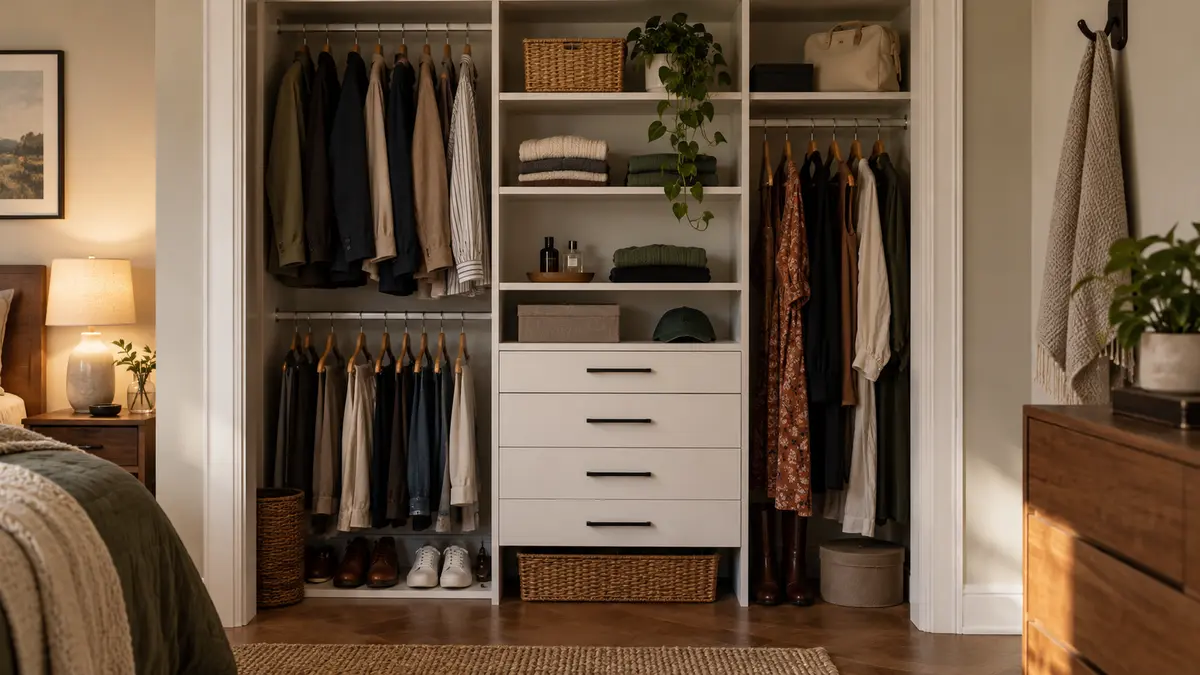
A small closet usually does not have a container problem. It has a space-allocation problem.
Before buying baskets, bins or a fancy organizer system, pull everything out and sort it by what it actually needs: long hanging space, short hanging space, shelves, drawers, shoes, bags and things you barely use. That boring step is where most of the improvement comes from.
Closet systems worth comparing
Measure the actual closet first, including doors, baseboards and trim. Then choose the system that fits those dimensions.
Measure the closet as a three-dimensional space
Wall-to-wall width is only the beginning.
Measure at several heights. Check door swing, baseboards, sloped ceilings, trim, outlets and anything else that steals space. Then measure the clothes themselves.
A shelf can fit perfectly on paper and still be useless if a coat hangs directly in front of it.
Double hanging is the easiest way to create space
If most of your clothes are shirts, jackets and folded-over pants, one rod at eye level wastes a lot of vertical room.
Two shorter hanging zones, one above the other, can nearly double usable hanging capacity.
Keep one full-height section for dresses, long coats or anything else that actually needs it.
Do not make shelves too deep
Deep shelves look generous until everything in the back disappears.
For folded clothes, moderate-depth shelves are easier to use. Very deep shelves often turn into two rows, and the back row becomes a textile archeological site.
If you need deep storage at the top, use labeled bins for seasonal items rather than stacking everyday clothes three feet deep.
Drawers hide clutter, but they need room to open
Drawers are great for underwear, socks and small items that turn open shelves into chaos.
Measure the clearance in front of them. A drawer unit that technically fits inside the closet is not useful if the closet door blocks it halfway open.
Shoes need visibility
A shoe organizer should make shoes easier to see and easier to clean around.
That is why I prefer open shelves or racks over a collection of opaque shoe boxes unless the boxes are clearly labeled.
Leave enough vertical clearance for the footwear you actually own. Sneakers, boots and heels do not all behave like the perfectly identical shoes in a product photo.
Wall-mounted systems use space efficiently
Wall-mounted tracks and uprights are usually the most flexible option because shelves and rods can be moved later.
The downside is installation. They need correct fasteners and solid attachment according to the manufacturer’s instructions.
If you rent or do not want to drill, a freestanding or tension system may be more practical.
Freestanding organizers are easy to change
A freestanding system can be assembled, moved and taken with you.
It also consumes floor space and may need anti-tip restraint depending on its height and design. The CPSC has guidance on furniture tip-over hazards. CPSC tip-over safety information is here.
Mock up the layout before buying
Painter’s tape is your friend.
Mark shelf heights, drawer widths and rod positions on the wall. Hang a few actual clothes where the rods would go. Open the closet door. Stand there and imagine using it every morning.
You will find bad ideas much faster with tape than after opening six boxes of organizer hardware.
My small-closet order of operations
- Remove what does not belong there.
- Measure the closet carefully.
- Reserve full-height hanging only for clothes that need it.
- Add double hanging for shorter garments.
- Use shelves for folded items and visible shoes.
- Add drawers only where they can fully open.
- Put rarely used items high.
A good closet organizer should make the stuff you own easier to reach. If it mainly gives you more attractive places to hide too much stuff, it has missed the point.
Shop by the criteria that matter
Amazon results change. Check each listing against the criteria in this guide.