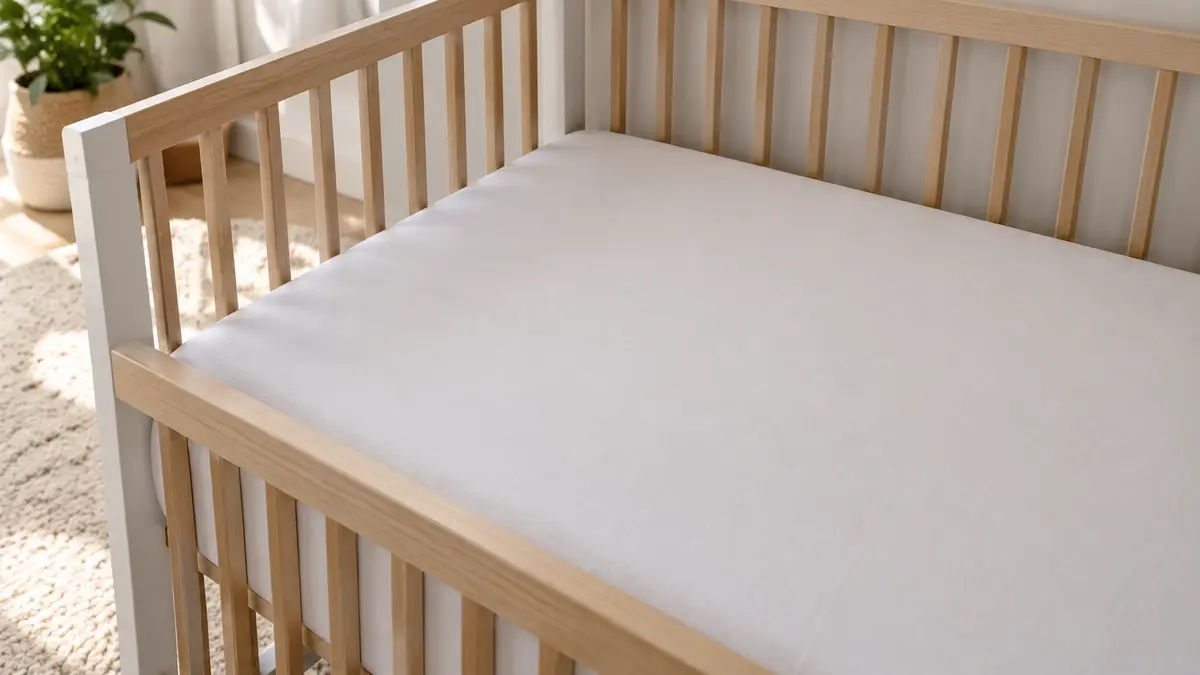
A crib mattress is one product where “soft and luxurious” is not the goal.
For an infant, you want a firm, flat mattress that fits the exact crib tightly. No plush topper. No pillow-like surface. No clever add-on intended to make the crib feel more like an adult bed.
Crib-mattress starting points
Verify the crib manufacturer’s required mattress dimensions and thickness before buying. Product search results are not a substitute for the crib manual.
Start with the crib, not the mattress
Full-size cribs, mini cribs, portable cribs and play yards do not all use interchangeable mattresses.
Find the model label and manual. Use the mattress dimensions and thickness that the manufacturer permits.
Do not assume that a mattress called “crib size” fits every product that looks like a crib.
The fit should be boringly snug
Install the mattress and inspect every edge and corner.
You do not want a significant gap where an infant could become trapped. If the mattress is obviously undersized for the crib, it is the wrong mattress no matter how nice the cover feels.
The CPSC has crib safety guidance that emphasizes a firm mattress and proper fit. CPSC crib safety tips are here.
Firm means firm
Adults tend to press a crib mattress and think, “That seems hard.” For infant sleep, that is not a flaw.
The surface should spring back rather than hold a deep impression. Soft, body-conforming surfaces and added cushioning do not belong in an infant sleep space.
Foam versus innerspring is not the important argument
Both foam and innerspring crib mattresses can be appropriate when they meet applicable safety requirements, are firm and fit correctly.
Foam mattresses can be lighter, which makes sheet changes easier. Innerspring mattresses may feel more familiar and substantial.
Buy the safer fit and construction, not the category name.
“Breathable” is not permission to ignore safe-sleep guidance
Some mattresses use mesh covers or market breathable cores.
Whatever the design, continue to follow established infant safe-sleep guidance. A breathable marketing claim does not turn soft bedding, positioners or loose objects into a good idea.
The cover needs to survive real life
Leaks happen. Spit-up happens. The fitted sheet will eventually be changed at a time when nobody involved is fully awake.
Look for a cover that is durable and cleanable according to the manufacturer. If it zips off, make sure it goes back on tightly and smoothly.
Dual-sided mattresses can make sense
Some crib mattresses have a very firm infant side and a somewhat different toddler side.
That can extend usefulness, but only flip the mattress when the manufacturer says the child is ready for the other side.
Skip the add-ons
Do not add aftermarket toppers, wedges, positioners or padding to “improve” the mattress unless a medical professional and the product instructions specifically direct otherwise.
The safe sleep surface is intentionally plain.
Check recalls and register the product
Save the model information and register the crib and mattress if registration is available.
That makes recall notifications and replacement information much easier to manage later.
My crib-mattress buying sequence
- Identify the exact crib.
- Read its mattress requirements.
- Choose a firm, flat mattress made for that size.
- Install it and check every edge for fit.
- Use only a properly fitted sheet.
- Skip soft add-ons.
- Register the products and check recalls.
A crib mattress does not need to feel inviting to an adult. It needs to fit, stay flat and do its very boring job correctly. In this category, boring is excellent.
Shop by the criteria that matter
Amazon results change. Check each listing against the criteria in this guide.