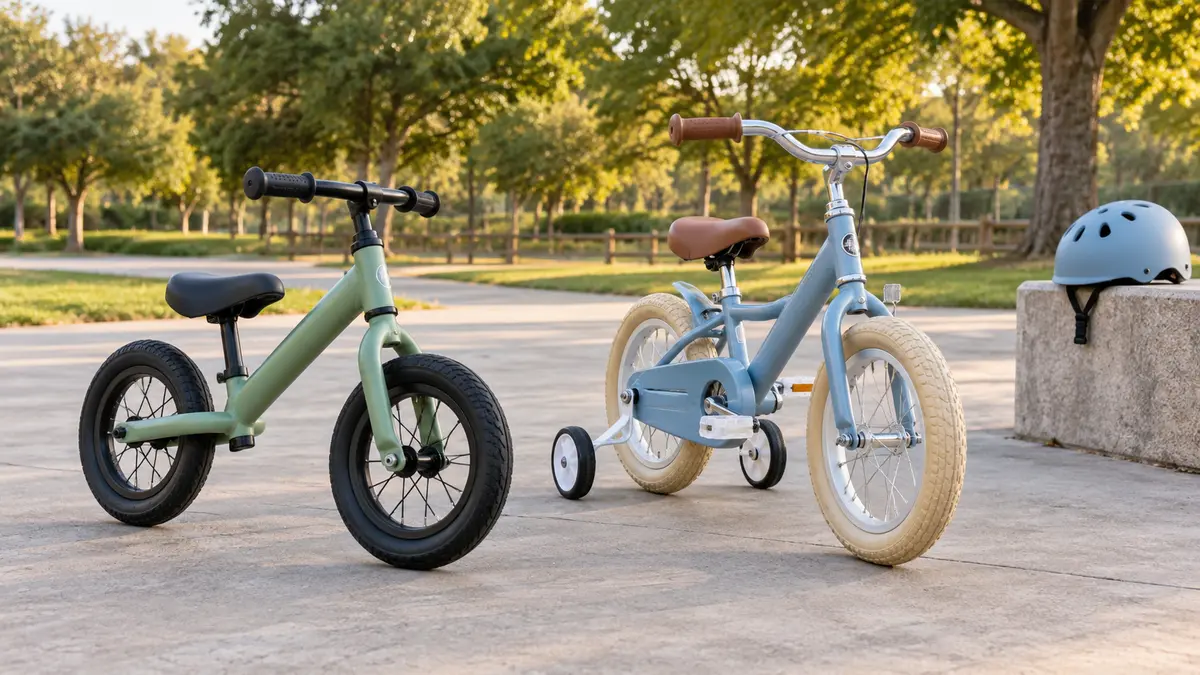
Balance bikes and training wheels both get kids to the same destination, but they teach the pieces in a different order.
A balance bike teaches balance and steering first. Training wheels let the child work on pedaling while the bike stays upright for them.
For many beginners, balance first makes the transition to a regular bike surprisingly simple. But the child’s confidence and the fit of the bike matter more than joining a parenting camp.
Beginner bike options to compare
Choose a bike the child can control now. Do not buy a size that only makes sense after a growth spurt.
What a balance bike teaches
There are no pedals. The child sits, pushes along with the feet and gradually starts lifting those feet to coast.
That teaches the part of bike riding that feels magical when it finally clicks: balance.
Because the child’s feet can reach the ground, stopping feels less scary too.
What training wheels teach
Training wheels hold the bike upright while the child practices pedaling and steering.
That can be useful for a child who loves pedaling, already has a pedal bike or needs more stability while gaining confidence.
The tradeoff is that training wheels prevent the bike from leaning normally through turns, so balance still has to be learned later.
Fit is more important than the method
On a balance bike, the child should be able to sit on the saddle and put both feet securely on the ground.
On a pedal bike, the exact fit depends on the bike and stage of learning, but the child still needs enough control to start, stop and steer without feeling like the bicycle is managing them.
Do not buy a bike two sizes too large because “they’ll grow into it.” That can turn learning into wrestling.
Weight matters a lot for small riders
A bike that feels light to an adult can be a huge percentage of a small child’s body weight.
Lighter bikes are easier to pick up, push, turn and recover when the child starts to lose balance.
This is one of the few times shaving several pounds off a product can make a very obvious difference.
Pneumatic tires ride better on rough surfaces
Air-filled tires generally provide more grip and cushioning on sidewalks, packed trails and bumpy pavement.
Foam or solid tires do not go flat and need almost no maintenance, but they can feel harsher and offer less traction depending on the surface.
A hand brake can be useful
Many balance-bike riders start by stopping with their feet. A child-sized hand brake introduces the braking motion before pedals are added.
Make sure the lever is actually small enough for the child’s hand and can be pulled without excessive force.
Use a helmet that fits now
A helmet should sit level and fit snugly according to the manufacturer’s instructions.
The CPSC has bicycle safety guidance for children and adults. CPSC bicycle guidance is here.
Practice somewhere boring
A flat, open paved area with no traffic is better than a hill, busy sidewalk or narrow driveway.
The first goal is not distance. It is repeated easy starts, stops and turns.
How the transition usually works
A child who can coast comfortably on a balance bike already understands balance. Add pedals and the new job is mostly learning to start and pedal.
A child using training wheels already understands pedaling. Remove the wheels and balance becomes the new job.
Both paths are legitimate.
Which would I choose?
For a young child starting from zero, I would lean toward a properly fitted balance bike because it isolates balance and gives the child easy foot contact with the ground.
If the child already owns a suitable pedal bike, loves pedaling or needs extra stability, removable training wheels can be perfectly reasonable.
The best learning tool is the one the child can control today and is excited to ride again tomorrow.
Shop by the criteria that matter
Amazon results change. Check each listing against the criteria in this guide.