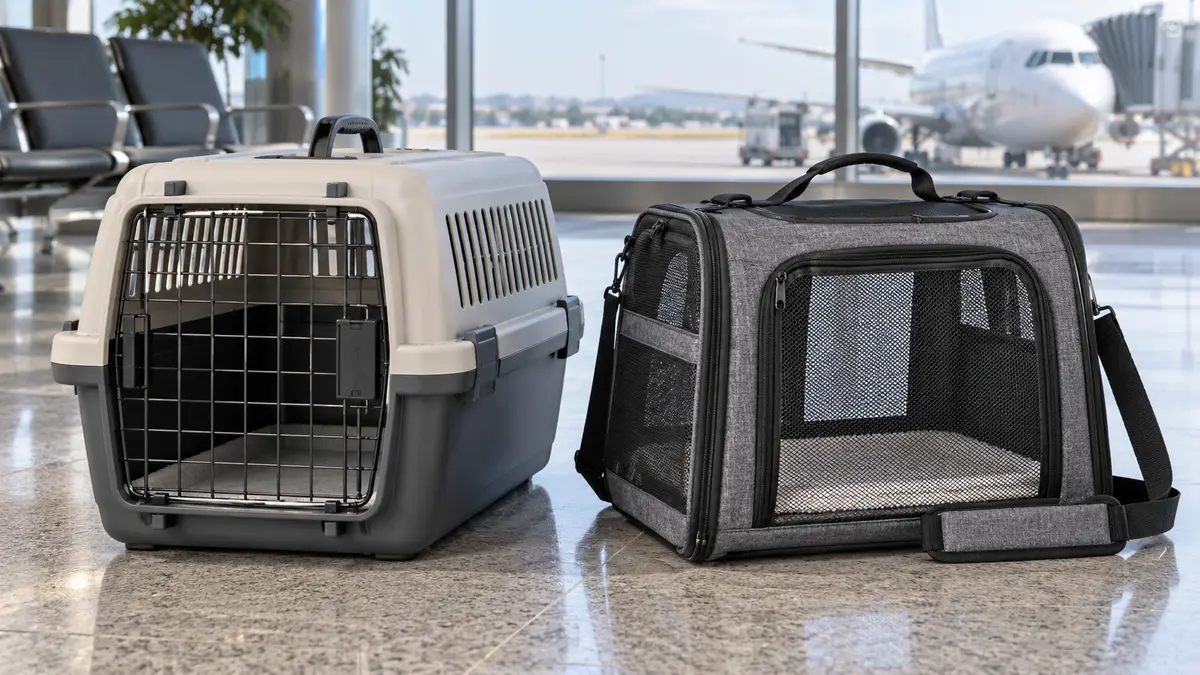
A cat carrier needs to work on the day your cat has decided that entering a carrier is the worst idea anyone has ever proposed.
That is why I care about the openings, floor and latches before I care whether the carrier is hard or soft. You need to be able to load the cat, carry it level and keep it closed.
Carrier styles to compare
Measure the cat and the carrier’s usable interior. Airline travel has separate trip-specific requirements.
Top loading is wonderfully useful
A front door is fine when the cat politely walks in.
A top opening is much easier when the cat plants all four feet around the doorway and becomes temporarily boneless.
For vet visits, I especially like carriers that open from the top or come apart easily so the cat can sometimes remain in the bottom half during part of the exam.
Hard carriers give you structure
A molded carrier keeps its shape if something bumps it and usually has a rigid floor that stays level.
They are easy to wipe clean and often have secure metal or plastic doors.
The tradeoff is bulk. They take up room at home and can be awkward to carry long distances.
Soft carriers are easier to carry and store
Soft-sided carriers are lighter, often have shoulder straps and can fit more easily in tight spaces.
The floor needs enough structure that it does not sag badly under the cat. Look at how the base panel is supported and whether it can be removed for cleaning.
Soft carriers are also more vulnerable to claws and determined chewing than a rigid shell.
Ventilation should be on more than one side
Mesh or openings on several sides allow airflow even if one side ends up against a seat or piece of luggage.
Make sure the cat cannot easily push a zipper apart from the inside. Locking zipper clips or clips that meet at one point can be useful on soft carriers.
Do not buy by weight limit alone
A carrier rated for a 20-pound cat can still be too short for a long 14-pound cat.
Measure nose to base of tail and floor to top of head while the cat is standing. The cat should be able to stand, turn and settle without being folded into the shape of the carrier.
The handle position changes how the carrier feels
A single handle on top can make a soft carrier tilt if the cat shifts to one end.
Two side handles or a properly attached shoulder strap may keep the base more level.
Test the carrier with realistic weight before putting the cat in it. A few dumbbells or bags of rice can tell you a lot about sag and balance.
Make the carrier normal before you need it
If the carrier appears only five minutes before a vet appointment, the cat has every reason to think it is an omen.
Leave it open in the house sometimes. Put familiar bedding inside. Toss treats in it. Let the cat investigate it without immediately being transported somewhere unpleasant.
That will not turn every cat into a carrier enthusiast, but it can make the object less suspicious.
Vehicle and airline use need specific instructions
Follow the carrier manufacturer’s vehicle-restraint instructions. Do not improvise a seat-belt route through a random handle unless the product is designed for it.
For airline travel, check the airline’s current carrier dimensions and pet policy for the exact trip. “Airline approved” on a listing is not a universal boarding pass.
The AVMA has general guidance for traveling with pets. AVMA pet-travel information is here.
My carrier checklist
- Enough room to stand, turn and settle.
- Top opening if possible.
- Secure latches or zippers.
- Ventilation on several sides.
- A floor that stays reasonably level.
- Surfaces you can clean after an accident.
- A carrying method you can manage with the cat inside.
The best carrier is the one you can actually get the cat into, close securely and carry without turning the trip into a two-person emergency operation.
Shop by the criteria that matter
Amazon results change. Check each listing against the criteria in this guide.