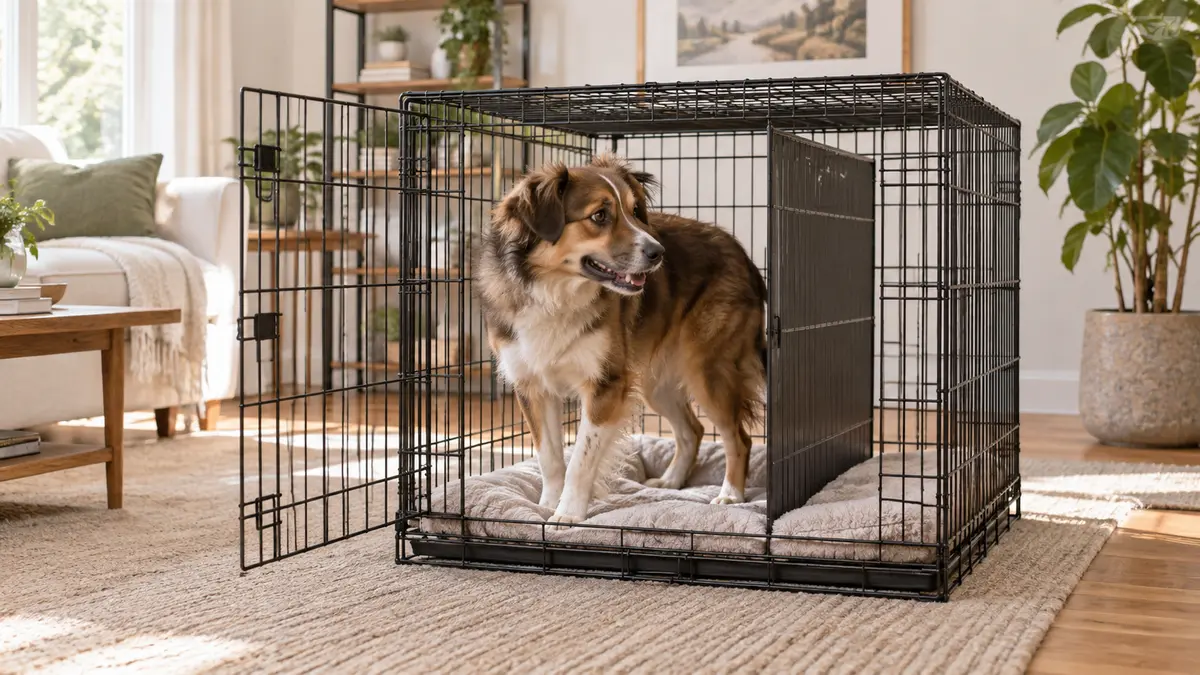
A dog crate should be big enough for the dog to stand normally, turn around and lie down comfortably. It should not be so cramped that the dog has to fold itself into a camping chair.
Breed charts are useful for guessing. The dog’s actual measurements are better.
Common crate styles to compare
Measure your dog before choosing a size. Product dimensions and weight limits are not substitutes for usable interior space.
Measure height with the dog standing naturally
Measure from the floor to the top of the head or upright ears, whichever is higher.
You want enough interior height that the dog can stand without ducking.
Measure length from nose to the base of the tail
Do not include the tail itself. Add a modest amount of room so the dog can turn and stretch out.
The exact extra allowance depends on the dog’s body shape and the crate design, which is why rigid “add exactly X inches” rules are less useful than checking actual movement.
Puppies usually need a divider
If you buy a crate sized for an adult dog, a divider lets you reduce the usable area while the puppy is small and move it as the dog grows.
That is much cheaper than buying four crates on the way to adulthood.
For housetraining, you generally do not want a huge crate where the puppy can sleep at one end and use the other end as a bathroom.
Wire crates are flexible and airy
Wire crates offer excellent ventilation and visibility. Many fold flat and come with dividers.
They can also feel exposed to some dogs. A safe cover over part of the crate may help a dog that settles better in a den-like space, as long as airflow remains good and the dog cannot pull fabric inside and chew it.
Plastic kennels feel more enclosed
Rigid plastic carriers can be useful for travel and for dogs that prefer a more sheltered space.
They are bulkier to store and usually offer less visibility than wire.
If you plan to use the crate for air or vehicle travel, follow the carrier, airline and transportation requirements for that specific trip.
Soft crates are for dogs you can trust
A soft crate is light, quiet and easy to pack.
It is not a good containment device for a dog that scratches, chews, panics or is determined to leave. Fabric and mesh lose that argument quickly.
Take collars and dangling gear seriously
For unattended crating, many trainers and safety sources recommend removing collars, tags or harnesses that could catch on crate hardware. Ask your veterinarian or qualified trainer what is appropriate for your dog and situation.
The AVMA has general pet-travel information, including the importance of secure carriers and planning ahead. AVMA travel guidance is here.
Do not use the crate as an all-day parking space
A crate is a management and rest tool, not a substitute for exercise, bathroom breaks and interaction.
If a dog panics, tries to injure itself escaping or cannot settle despite gradual positive introduction, making the crate stronger is not always the answer. Talk with a veterinarian or qualified behavior professional.
Placement matters
Put the crate somewhere the dog can rest without being isolated in a furnace room or planted in the middle of constant traffic.
Avoid direct sun, heating vents and places where the crate blocks a doorway.
My crate-size test
Inside the crate, the dog should be able to:
- stand normally,
- turn around without struggling,
- sit without hitting the roof,
- lie on its side or in its normal resting position.
Measure the dog, then compare those measurements with the crate’s interior dimensions when possible. The picture of a Labrador beside a “Large” label is not a measuring tool.
Shop by the criteria that matter
Amazon results change. Check each listing against the criteria in this guide.