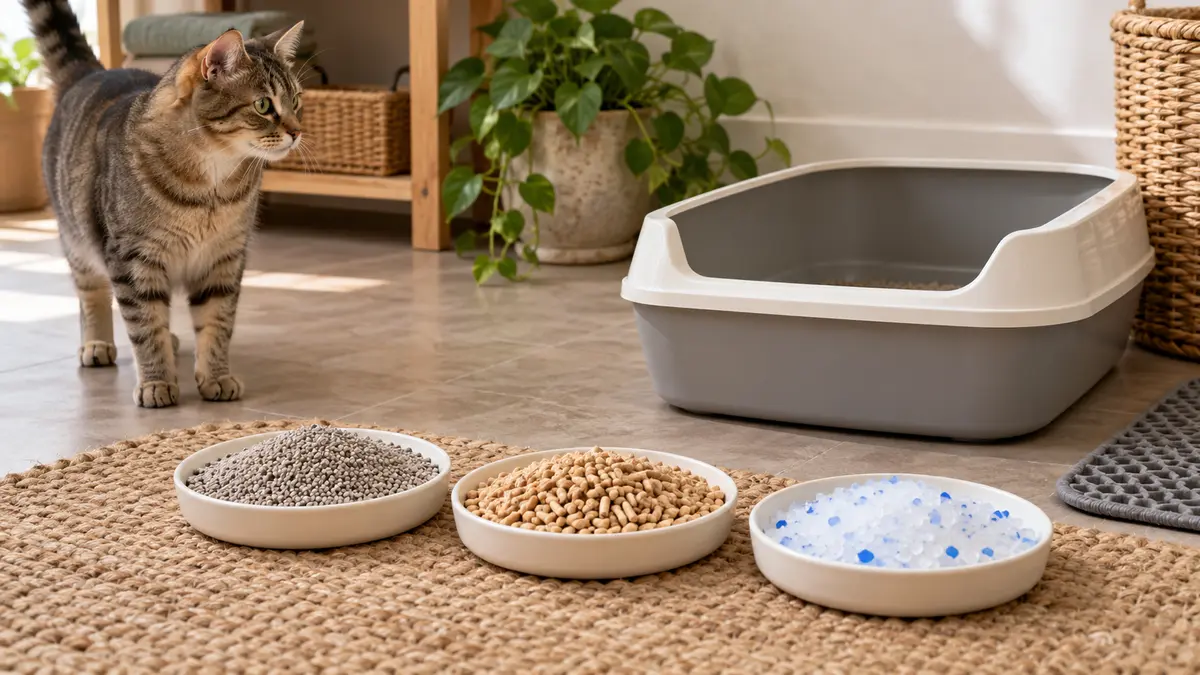
The cat gets the final vote on cat litter.
You can buy the lowest-dust, most eco-friendly, beautifully packaged litter in the world, and if your cat stands outside the box looking at you like you have committed a personal betrayal, the experiment is over.
For many cats, a good starting point is unscented litter with a fairly fine texture. After that, clumping, dust, tracking, odor control and disposal become household choices.
Common litter types to compare
Buy one bag before committing to a giant supply. Cats can be extremely specific about texture and scent.
Clumping clay makes daily scooping easy
Clumping clay forms a removable mass around urine, so you can take out wet litter without dumping the whole box.
That is convenient and usually makes it easy to keep the box clean between full changes.
Quality varies. Some litters make hard clumps. Others make something closer to damp oatmeal that falls apart when the scoop looks at it.
Non-clumping clay is simple but requires more full changes
Non-clumping litter absorbs urine rather than creating scoopable clumps.
It can be inexpensive and works fine for cats that prefer it, but wet litter stays mixed in until you replace more of the box.
Silica crystal litter handles moisture differently
Silica crystals absorb moisture into the granules and can last longer between full changes in some households.
The texture is very different from fine clay. Some cats do not care. Some absolutely care.
Crystal litter can also make a distinctive crunch underfoot, which is another reason to change gradually.
Plant-based litter is a whole category, not one product
Corn, wheat, wood, grass and other plant materials are used in cat litter.
Some clump well. Some track less. Some are very light and escape the box like confetti.
Judge the actual formula, not the fact that it came from a plant.
Dust matters to both cat and human
Do not judge dust only from the claim on the bag.
Watch what happens when you pour it and when you scoop. A cloud every time you add litter is more useful information than “99% dust free” in giant print.
I would start with unscented
Strong fragrance is designed for the human standing outside the box. The cat is standing much closer to it.
If odor is a problem, more frequent scooping, enough litter depth and a properly sized box are better places to start than trying to make the box smell like tropical flowers.
Tracking is partly a litter problem and partly a box problem
Fine, light granules stick to paws and fur more easily.
A large litter mat and a roomy box can reduce the amount that reaches the rest of the house. Long-haired cats may track more regardless of the brand.
Change litter gradually
If the current litter is working and you want to switch, mix increasing amounts of the new litter into the old over several days.
That gives the cat a chance to adjust to the texture and smell without suddenly finding an unfamiliar box.
Watch for medical problems, not just preferences
A cat suddenly urinating outside the box, straining, making frequent trips, crying, passing blood or being unable to urinate may have a medical problem.
That is especially urgent in a cat that appears unable to pass urine. Do not assume a sudden litter-box change is behavioral.
Cornell’s Feline Health Center has reliable general cat-health information. Cornell feline health resources are here.
Buy one bag, not a pallet
Try the litter in one box. Watch the cat. Scoop it. See how much ends up on the floor and how quickly odor becomes a problem.
Then decide whether you want six more bags.
The “best” cat litter is the one the cat willingly uses, you can keep clean and your household can tolerate. The cat’s opinion outranks the packaging.
Shop by the criteria that matter
Amazon results change. Check each listing against the criteria in this guide.