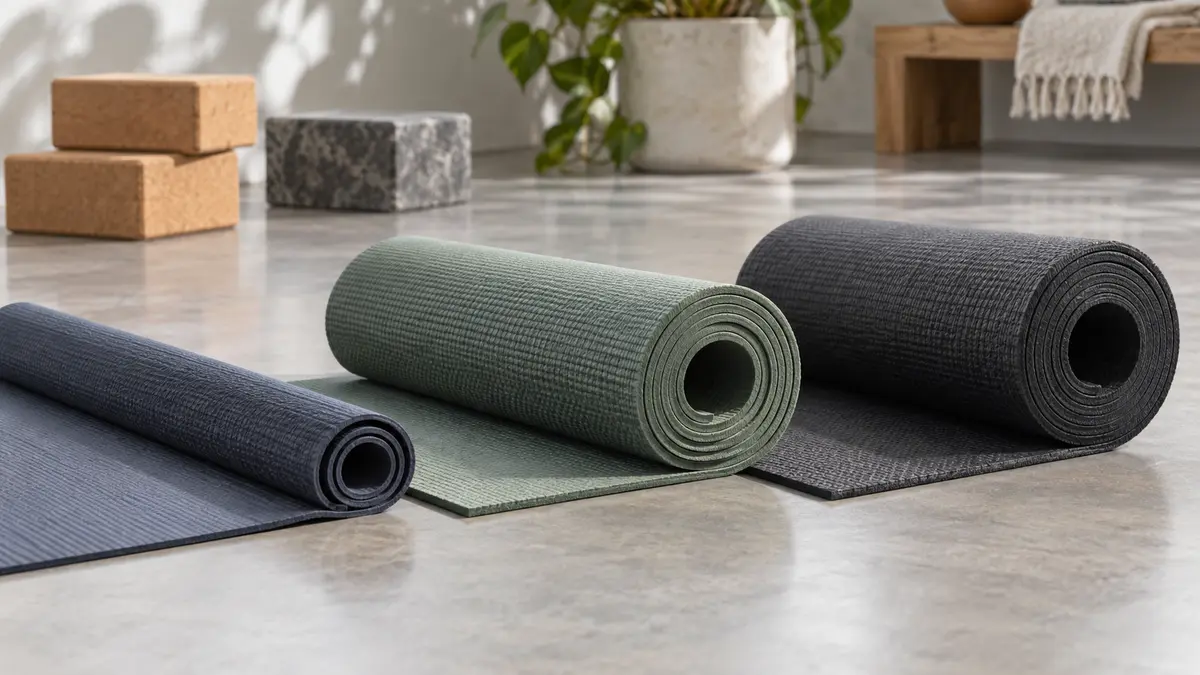
A thicker yoga mat is not automatically a better yoga mat.
More cushioning can make kneeling feel nicer, but it can also make standing balance less stable. The useful question is how much cushioning can you add before the mat starts feeling squishy under your feet?
Common mat constructions to compare
Thickness, density and surface grip all matter. A 6 mm mat can feel firmer than a softer 4 mm mat.
Thickness and density work together
A dense 4 mm rubber mat can feel more stable and supportive than a soft 6 mm foam mat.
If your knees need more cushioning, a thicker mat may help. If balance poses are the priority, too much soft foam can make the floor feel farther away.
Dry grip and sweaty grip are different
A mat can feel sticky under dry hands and turn slippery as soon as you sweat.
If you practice hot yoga or sweat heavily, look specifically for reviews and materials that address wet grip.
Try downward dog and a wide standing pose. Those reveal sliding much faster than simply standing upright on the mat.
Open-cell mats absorb more
Open-cell surfaces can provide strong grip because they absorb some moisture.
They also absorb sweat and take more effort to clean and dry.
Closed-cell mats resist moisture and wipe clean more easily, but sweat stays on the surface where it can make some materials slippery.
Natural rubber is grippy and heavy
Rubber mats are popular because they tend to provide excellent traction and a dense feel.
They can be heavy, have a noticeable odor when new and may not be appropriate for people with latex allergy depending on the product.
TPE and foam mats are lighter
They are easier to carry and often less expensive.
Durability and grip vary widely, so I would not judge all synthetic mats by the material label alone.
Size matters if you are tall
Standard yoga mats are long enough for many people, but tall users may end up with hands or feet on the floor during lying poses.
Measure yourself against the mat length instead of assuming every “standard” is generous.
Weight determines whether the mat leaves the house
A heavy rubber mat can feel fantastic at home and become less charming on a ten-block walk to class.
If you travel with the mat, compare packed weight and thickness before buying the heaviest premium option.
Cleaning needs to match the material
Follow the manufacturer. Some rubber mats do not like harsh cleaners. Open-cell mats may need more drying time.
Do not roll a damp mat tightly and leave it in a hot car unless you enjoy opening a very expensive burrito of funk later.
Do the pose test during the return period
Try:
- kneeling,
- downward-facing dog,
- one-foot balance,
- a plank,
- and a few transitions.
Notice cushioning, grip, edge curling and whether the mat stretches under load.
ACE has general exercise and fitness resources if you are building or modifying a practice. ACE resources are here.
The right yoga mat is the one that disappears under you. Enough cushioning, enough grip, not so much squish that every balance pose turns into a small negotiation.
Shop by the criteria that matter
Amazon results change. Check each listing against the criteria in this guide.