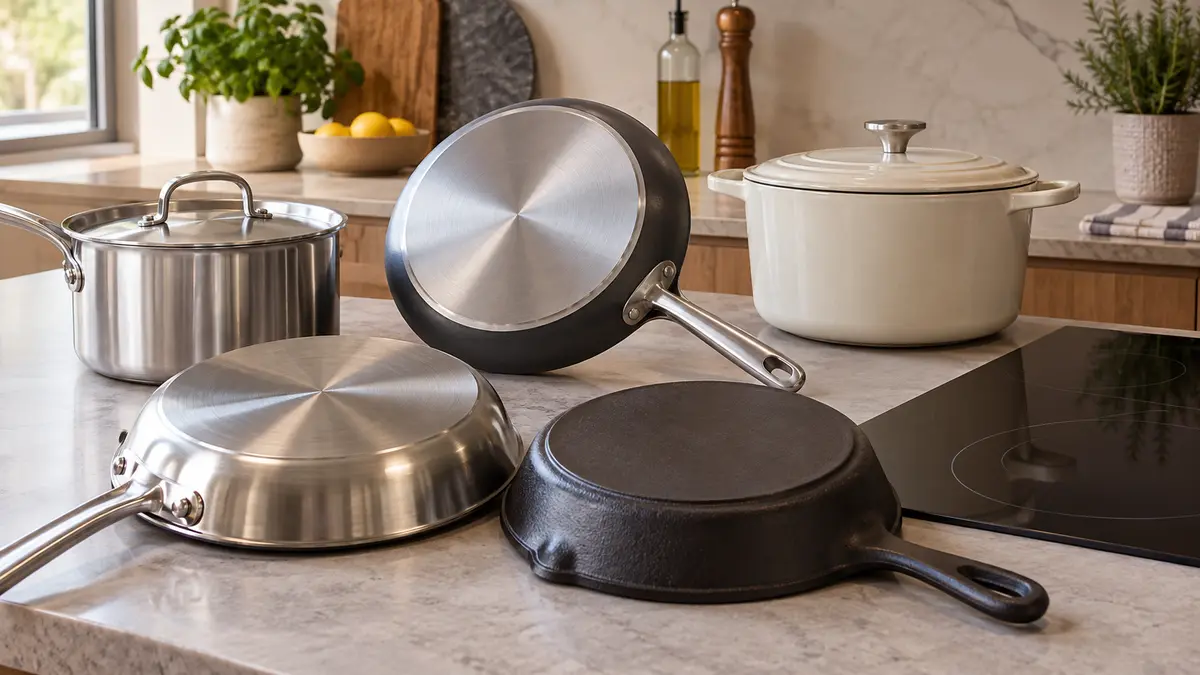
Induction cookware shopping has one annoying little trap: a pan can technically be induction-compatible and still be a lousy match for your cooktop.
A magnet sticking to the bottom tells you the cooktop may recognize the pan. It does not tell you how large the magnetic area is, whether the base is flat or how evenly heat will spread.
Induction-ready cookware worth comparing
Check the actual base diameter and manufacturer compatibility information, not just the word “induction” in the title.
Why induction needs a magnetic base
Induction cooking uses a magnetic field to create heat in compatible cookware. The pan heats directly rather than sitting over a glowing electric element or gas flame.
The U.S. Department of Energy has a useful overview of how induction works. You can read it here.
Cast iron generally works because it is magnetic. Many stainless pans work because their outer layer or base is magnetic. Plain aluminum and copper do not work unless the manufacturer adds a compatible magnetic layer.
The refrigerator-magnet test is useful, but incomplete
If a magnet will not stick firmly to the bottom, the pan is not a good candidate for induction.
If it does stick, you have passed the first test. Now look at where it sticks.
A wide skillet with a small magnetic disk bonded to the center may activate the burner but concentrate heat in the middle. A fully clad pan with a broad magnetic exterior can give the cooktop more area to work with.
Match the base to the burner, not the rim to the burner
The cooking surface can be much wider than the flat magnetic base underneath. That matters on induction.
Turn the pan over and measure the flat contact area. Compare that with the cooktop manufacturer’s recommended pan sizes for each zone.
If the base is dramatically smaller than the cooking zone, you may get uneven heating. If it is too small, some cooktops may not detect it reliably at all.
Flatness really matters
Induction works best when the base sits close to the glass. A pan that rocks or has developed a dome can be noisy, heat unevenly or behave unpredictably.
Set a new pan on a flat counter before you remove the packaging. Press around the rim. If it rocks noticeably, I would exchange it.
Clad stainless is the easiest general recommendation
For an all-purpose induction pan, fully clad stainless with a magnetic exterior is hard to argue with. It gives you a durable cooking surface and a conductive core that spreads heat beyond the induction zone.
It is not naturally nonstick, and technique matters, but it handles acidic foods and high heat better than many coated pans.
Cast iron works beautifully, with two cautions
Cast iron is naturally induction-compatible and holds heat extremely well.
It is also heavy, and the bottom can be rough. Lift it instead of sliding it across the glass. A clean, flat base helps protect the cooktop surface.
Enameled cast iron gives you the induction performance of iron with a nonreactive cooking surface, although it is still heavy.
Carbon steel can be a terrific induction pan
Carbon steel is magnetic, lighter than cast iron and very responsive once it is hot. Make sure the base is flat. Thin pans can warp if they are blasted with maximum power while empty.
Induction can deliver heat very quickly, so there is rarely a good reason to use “boost” as your default preheat setting.
Listen for noise, but do not panic at every buzz
Some cookware hums or buzzes on induction, especially at high power. Layered pans and loosely fitting lids can amplify the sound.
A faint buzz is not necessarily a defect. A pan that rattles, rocks or behaves erratically deserves a closer look.
Everything else about cookware still matters
An induction-compatible pan can still have a terrible handle, a useless lid or enough weight to make you avoid it.
Our broader cookware buying guide covers materials, coatings, handles and the “do I really need this whole set?” question.
My quick buying test
- Does a magnet stick strongly across most of the base?
- Is the flat base wide enough for the burner I plan to use?
- Does the pan sit completely flat?
- Is there enough conductive material to spread heat across the cooking surface?
- Can I comfortably lift the pan when it is full?
- Do the oven limits and care instructions fit the way I cook?
“Induction compatible” gets a pan through the front door. The better question is whether the base, size and construction make it a good partner for your particular cooktop.
Shop by the criteria that matter
Amazon results change. Check each listing against the criteria in this guide.