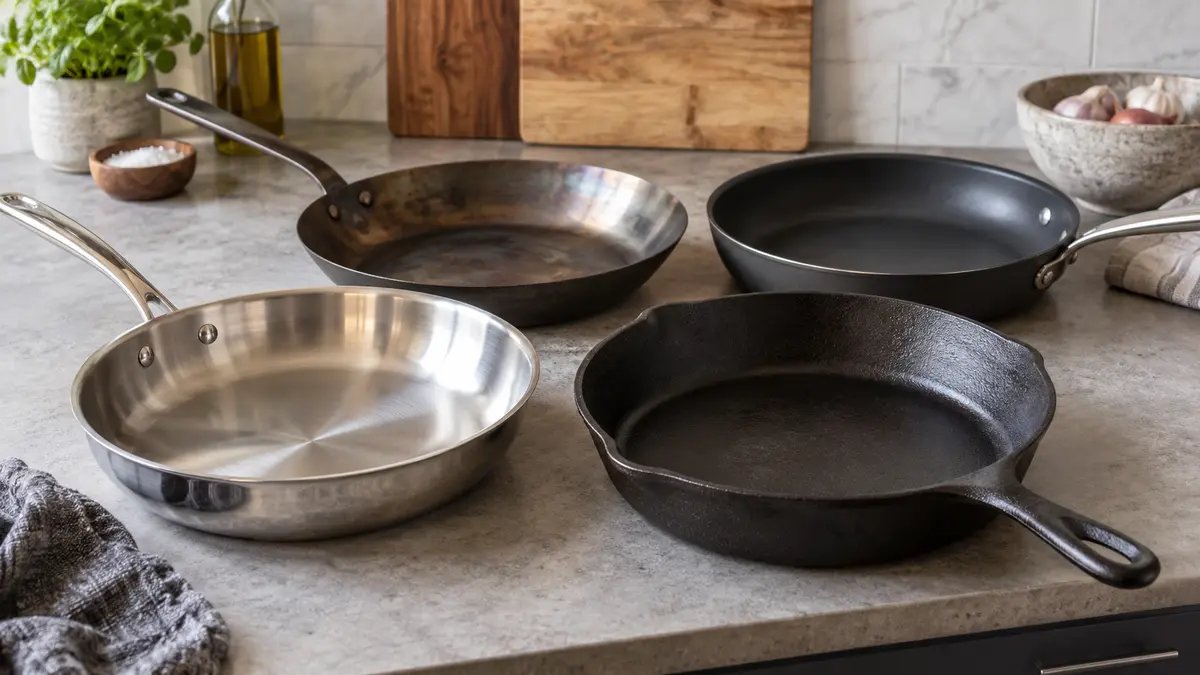
Most people do not need a twelve-piece cookware set. They need a few pans that do their jobs well and do not make dinner harder than it needs to be.
If I were starting over, I would think in jobs first: frying eggs, searing meat, making sauce, boiling pasta, cooking acidic food, going from stovetop to oven. Then I would choose materials for those jobs.
Useful cookware types to compare
These searches are starting points. Check diameter, weight, handle design, oven limits and cooktop compatibility on each listing.
Stainless steel is the dependable all-rounder
Good clad stainless cookware is hard to beat for general use. It does not need seasoning, handles acidic foods well and can last for decades.
The important word is clad. Stainless steel itself is not a great heat conductor. Better pans sandwich aluminum or another conductive material between layers of stainless so the heat spreads across the cooking surface.
Tri-ply is a common construction and a perfectly sensible place to start. More layers are not automatically better.
Cast iron is great when you actually want cast iron
Cast iron holds heat well, is inexpensive and can move from stovetop to oven without drama. It is terrific for searing, frying and baking.
It is also heavy. A 12-inch skillet loaded with food is not subtle.
Bare cast iron needs to be dried and maintained so it does not rust. Enameled cast iron removes the seasoning issue but adds cost and a coating that can chip if abused.
Carbon steel sits between stainless and cast iron
Carbon steel gives you many of the same high-heat advantages as cast iron in a thinner, lighter pan. It heats and cools faster and develops a seasoned surface with use.
Like bare cast iron, it can react with acidic foods and needs to be dried properly. It is a great tool if you enjoy maintaining cookware. It is not a great tool if you want every pan to go straight into the dishwasher.
Nonstick is useful, but I would not build the whole kitchen around it
A nonstick skillet makes eggs, delicate fish and low-fat cooking easier. The coating is also a wear item.
Use moderate heat, avoid metal utensils unless the maker explicitly allows them and replace the pan if the coating is badly damaged or peeling.
I would rather buy one good nonstick skillet and accept that it will eventually be replaced than pay for an enormous matching set whose most vulnerable surface is on every piece.
Aluminum is everywhere because it works
Aluminum conducts heat well and keeps cookware relatively light. It is often anodized, coated or used as the conductive core inside stainless cookware.
That is why “stainless steel pan” and “aluminum pan” are not always opposites. Many excellent stainless pans rely on aluminum inside.
Handles matter more after the pan is full
Pick up a pan with one hand and imagine another five pounds of food in it. A handle that feels stylish when empty can feel awful when you are carrying hot sauce to the sink.
Check the shape, angle and attachment. Rivets are common and durable, although food can collect around them. Welded handles give you a smooth interior but depend heavily on the quality of the weld.
Lids should fit without becoming a storage puzzle
Glass lids let you see inside but are heavier. Metal lids are lighter and harder to break.
I like sets where one lid fits more than one pan. That saves cabinet space and gives you fewer orphaned lids to deal with later.
Induction changes the base requirement
If you use induction, the pan needs a magnetic base that couples properly with the cooktop. A refrigerator magnet sticking to the bottom is a quick screening test, but it does not tell you how evenly the pan will heat.
We have a separate induction cookware guide because that topic deserves more than a checkbox.
Do not pay for pieces you will never use
For many kitchens, a 10- or 12-inch skillet, a medium saucepan and a larger pot cover an enormous amount of cooking. Add a Dutch oven, stockpot or specialty pan only when your meals justify it.
A 14-piece set can look like a bargain until you realize six “pieces” are lids and two pans have been living untouched behind the mixing bowls for three years.
Health Canada has a useful overview of common cookware materials and safe-use considerations. You can read it here.
The best cookware collection is usually smaller than the catalog wants you to buy. Choose materials that fit the jobs, handles that feel good when the pan is full and care requirements you can live with on an ordinary Tuesday night.
Shop by the criteria that matter
Amazon results change. Check each listing against the criteria in this guide.