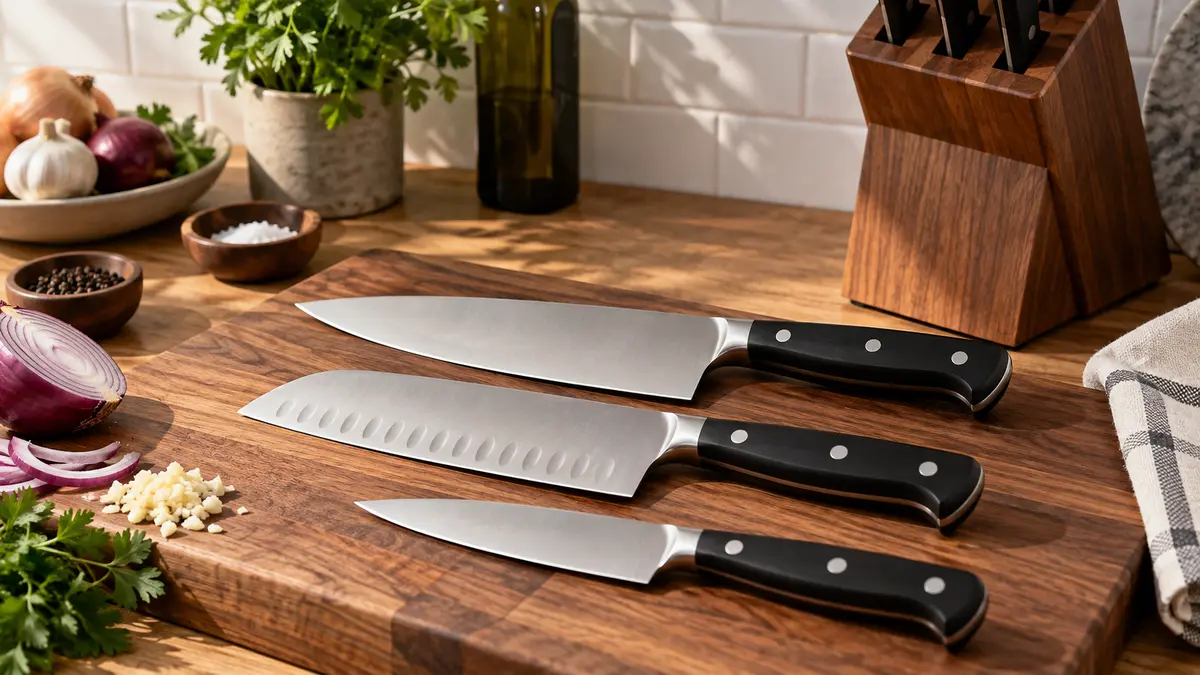
You do not need a giant knife block to have a good kitchen. You need a few knives that feel right in your hand, cut the things you actually cook and can be sharpened when the factory edge is long gone.
For most home cooks, that means a chef’s knife or santoku, a small paring knife and a serrated bread knife. Everything else should have to earn its drawer space.
Simple knife setups to compare
A sharp new knife can make almost anything look impressive. Pay attention to handle fit, blade geometry and how you will sharpen it later.
Start with the knife you will use every day
An 8-inch chef’s knife is the standard answer because it can handle onions, meat, herbs and most other prep without feeling enormous.
A santoku is usually a little shorter and has a flatter edge profile. Some people prefer that for straight up-and-down chopping.
Neither is “better.” Pick up both if you can. The one that immediately feels less awkward is already telling you something useful.
Handle fit is hard to buy from a photograph
This is one of those products where holding it matters.
A handle can be beautifully finished and still feel wrong if it is too thick, too thin, too square or slippery in your hand. If you pinch-grip the blade near the bolster, make sure that area does not have sharp edges.
Also pay attention to how the knife balances. A heavy handle can make a small knife feel clumsy. A blade-heavy knife can be tiring if you do a lot of fine prep.
Steel names are not the whole story
Knife makers love alloy names and hardness numbers. They matter, but blade geometry and heat treatment matter too.
A very hard blade may hold an edge longer but can be more prone to chipping and harder to sharpen. A slightly softer stainless blade may need more frequent touch-ups but be easier to maintain.
For a normal home kitchen, I care more about whether the manufacturer has a good sharpening reputation and whether I can keep the edge working than whether the steel name looks impressive on a product page.
Factory sharpness is temporary
Every knife review that begins and ends with “it sliced paper out of the box” is missing the interesting part.
Of course it is sharp. It is new.
The question is what happens after six months. Can you hone it? Can you sharpen it? Is there a local service or a sharpening system you are comfortable using?
A $40 knife you can maintain is more useful than a $200 knife you are afraid to touch once it gets dull.
Full tang is nice, but not a magic spell
In traditional Western knives, a full tang means the steel extends through the handle. It can add strength and balance.
Plenty of excellent modern knives use other construction methods. I would not reject a well-made knife solely because it does not show a dramatic strip of steel running through the handle.
What matters is that the handle is secure and stays that way.
Damascus patterns are mostly about looks
Layered or patterned steel can be beautiful. It does not automatically make a knife cut better.
If you love the look, great. Just do not let decorative patterning distract you from the edge geometry, handle and actual maintenance requirements.
Skip the giant block unless you really need the pieces
Knife blocks are good at making a countertop look complete. They are also good at selling six knives you may barely use.
I would rather buy three useful knives and good storage than pay for a steak-knife army and something labeled a “utility slicer” that never leaves the block.
Storage and cutting surface matter
Do not throw a good knife loose in a drawer. Use a block, magnetic strip, drawer insert or blade guard that protects both the edge and your fingers.
And give it a reasonable cutting surface. Our cutting-board guide explains why glass and stone are rough on knife edges.
NSF has practical guidance on cleaning kitchen items and food-contact surfaces. You can read it here.
The small kit I would build
- One chef’s knife or santoku that genuinely fits your hand.
- One paring knife.
- One serrated bread knife.
- Safe storage.
- A sharpening plan.
- A cutting board that does not beat up the edges.
Then add specialty knives when you have a repeated job that justifies one. Empty slots in a knife block are not an emergency.
Shop by the criteria that matter
Amazon results change. Check each listing against the criteria in this guide.