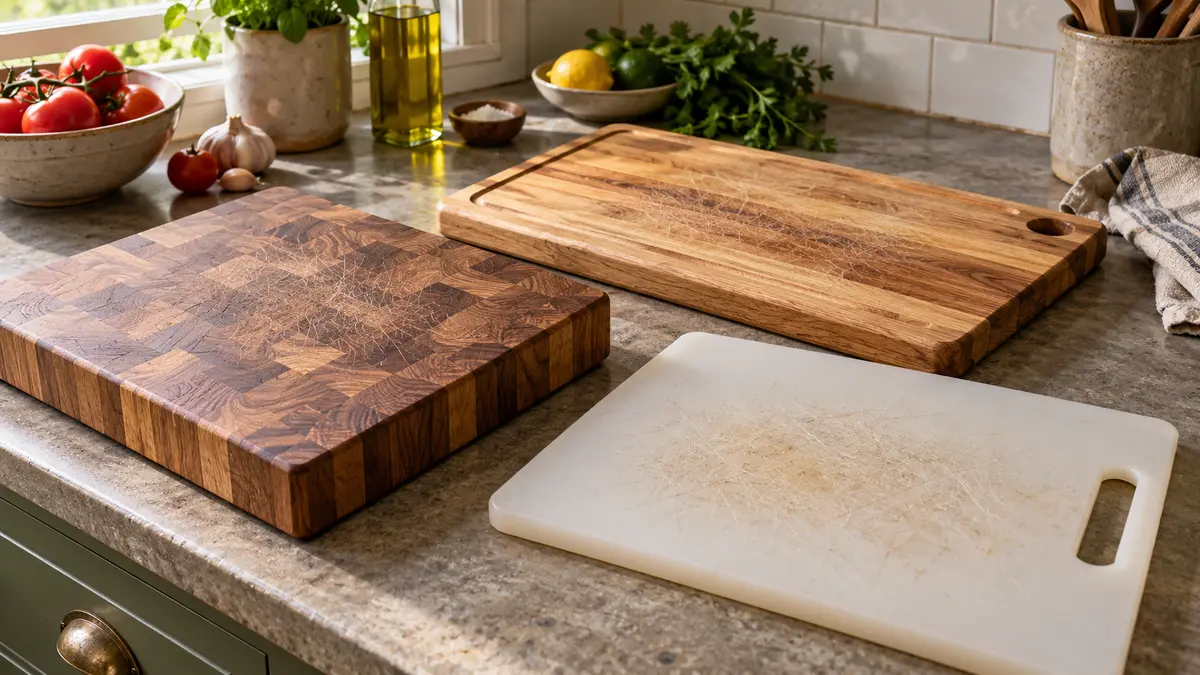
You can spend an absurd amount of time arguing about cutting-board materials. Most of that debate skips the thing that matters first: is the board big enough to work on, stable on the counter and easy enough to clean that you will actually use it?
Wood and plastic can both be good choices. Rubber can be excellent too. Glass looks tidy and is easy to wash, but it is miserable on knife edges.
Three useful board styles to compare
Amazon results change. Check dimensions, thickness, care instructions and whether the board will fit your sink and storage space.
Buy the size you can actually wash
A giant board is wonderful until you discover that it does not fit under the faucet.
For general kitchen prep, something around 18 × 12 inches gives many people enough room to cut without chasing onions onto the counter. But measure your sink, dishwasher if relevant, cabinet and counter first.
You want enough space for the ingredient, your knife and a little clear area for finished pieces.
Wood feels great under a knife
A good wood board is kind to knife edges and pleasant to work on. Maple, walnut and similar hardwoods are common choices.
Edge-grain boards are usually less expensive and lighter. End-grain boards are thicker, heavier and often more expensive, but many cooks like the way the knife edge meets the surface.
Wood does require some cooperation. Hand-wash it, dry it promptly and do not leave it soaking in the sink. If that sounds like a routine you will resent by Thursday, buy something else.
Plastic is practical for a reason
Plastic boards are light, inexpensive and often dishwasher-safe. They make a lot of sense for raw meat or any job where easy sanitation matters.
The downside is wear. Deep knife grooves get harder to clean, and thin boards can warp. Once a plastic board looks like it has spent a decade fighting a lawn mower, replace it.
Rubber is worth considering
Rubber cutting boards are common in professional kitchens for good reasons. They are usually gentle on knife edges, resist slipping and can be easier to maintain than wood.
They can be heavier and more expensive than basic plastic, and care instructions vary, so check whether the specific board can go in a dishwasher.
Glass and stone are better serving surfaces than cutting surfaces
They are easy to wipe clean. They are also hard enough to dull a good knife quickly and loud enough to make chopping sound like home construction.
If you like the look of glass or marble, use it for serving, rolling dough or other jobs that do not involve repetitive knife work.
Stability is a safety feature
A cutting board that scoots around the counter is not a minor annoyance when you are holding an eight-inch chef’s knife.
Rubber feet can help, but they also prevent you from flipping the board over. A damp kitchen towel or a piece of non-slip mat underneath a flat board works well too.
Whichever method you use, the board should stay put when you push sideways on it.
You can safely use wood or plastic if you clean them properly
The USDA says consumers may use wood or nonporous cutting boards and recommends washing boards with hot, soapy water after each use. It also recommends replacing excessively worn boards that develop hard-to-clean grooves. USDA cutting-board guidance is here.
For raw meat, poultry and seafood, many people like keeping a separate board so there is less chance of cross-contamination with food that will be eaten without further cooking.
Your board and your knife are a team
If you spent money on decent kitchen knives, give them a surface that does not punish the edge. Our kitchen-knife guide covers the other half of that decision.
What I would buy for a normal kitchen
I like the idea of one substantial wood or rubber board for everyday vegetable and general prep, plus an inexpensive plastic board for messy jobs and raw meat.
That gives you a pleasant main work surface without turning every chicken breast into a maintenance ritual.
The best cutting board is not the material that wins an internet argument. It is the one that gives you enough room, stays put, does not wreck your knives and gets cleaned properly after dinner.
Shop by the criteria that matter
Amazon results change. Check each listing against the criteria in this guide.